

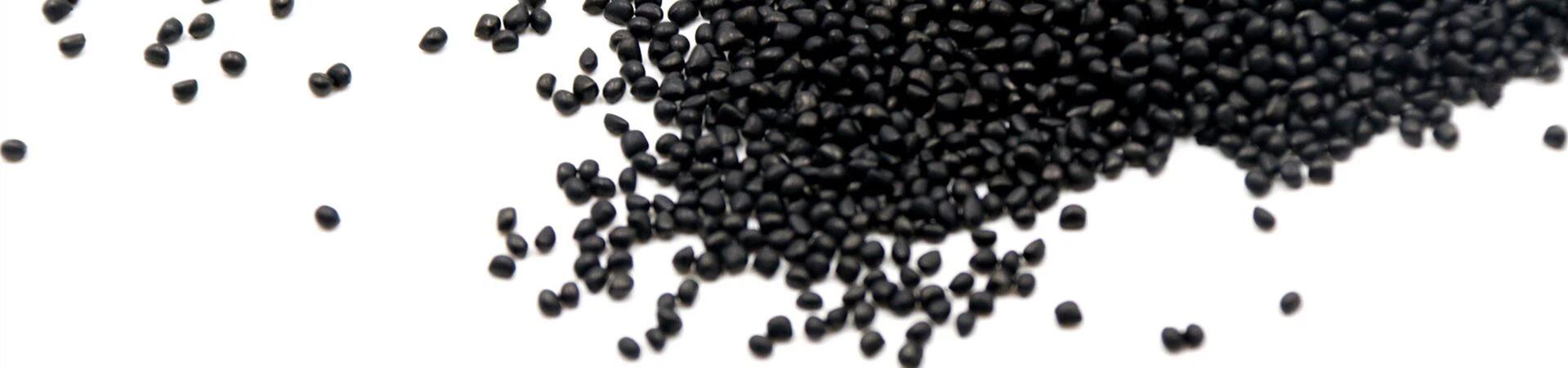
We can mix the masterbatch and the slice in the melt injector and look at the blending of the two polymers. The knowledge of polymer blending is used to analyze the plasticization and dispersion process of the two components in the above blending process. The masterbatch and the slice are completely compatible, so the melt mixing between them only needs to be dispensed and mixed. This mixing is carried out effectively, and the stress must be transferred from one material to the other. When the viscosity of the materials is similar, the stress transfer is the easiest, and when the viscosity of the two materials is too different, and the viscosity is low (in the system composed of the masterbatch, especially the black masterbatch and the slice, the melt viscosity of the slice is generally lower than that of the masterbatch. When the content of the component is large, the low-viscosity component may "submerge" the high-viscosity component, so that the stress transfer in the melt will be quite difficult, and even if the energy is increased (increasing the rotation speed or raising the temperature, etc.), it is difficult to melt the high-viscosity polymer. This will result in the presence of unplasticized particles in the melt. Even if the temperature is so high that the polymer is overheated, these particles cannot be eliminated. In summary, it is necessary to make the masterbatch and the slice have similar viscosity in the plasticizing environment of the melt injector, in order to obtain a plasticized and well-dispersed melt. On the other hand, it is possible to improve the melt dispersion of the masterbatch and the chip by increasing the plasticizing ability of the device, for example, reducing the depth of the groove to achieve "thin layer" plasticization, which can achieve masterbatch and slicing with large differences in melt viscosity. Melt evenly.
Precautions for use of masterbatch:
1. When using masterbatch injection molding products, the injection molding machine used is preferably screw type, otherwise the coloration is uneven due to poor plastic mixing;
2. Increase the extrusion back pressure to improve the mixing effect of the screw, which can make the masterbatch diffuse more evenly.
3, there are many solemn, elegant high-grade colors and some such as imitation porcelain, flash color, must be in the mold is very bright to show its effect
4. During the operation, if the masterbatch is found to adhere to the wall of the hopper, this is due to static electricity. The hopper can be grounded to eliminate static electricity, and it will not be caused by process problems.
5, the color masterbatch will absorb moisture for a period of time, especially PET / ABS / PA / PC, etc., it is necessary to dry according to the same process requirements of the color particles to achieve water requirements
Masterbatch and other additives will react, pay attention when using
About the understanding that the white mother is easy to become brittle after film formation:
Due to the nature of PET materials, environmentally friendly materials have poor weather resistance;
During the processing, if the white mother (titanium dioxide) stays in the feed section of the high-speed mixer or extruder for too long, some surface treatment layers may be damaged due to severe friction, even if high-efficiency antioxidants are added to the plastic products. , light stabilizers, the actual aging resistance of the products will also be discounted;
Since the antioxidant light stabilizer is mostly powder crystal, it is not easy to be added to the PET pellet. It is recommended to add some toughener or tackifier separately.
For a crystalline polymer such as polyester, the flow changes from a solid state to a flow, and the process only changes from crystal to melt. Therefore, when the plastic changes from a state where the apparent density is small to a melt, The volume is suddenly reduced, so the corresponding compression ratio must be set in the melt plasticizing section. If the compression ratio is too small, the air in the polyester chip is difficult to drain, which will result in oxidation and yellowing. Containing gas.


